The client
HP wanted its printers to earn their keep beyond the office document. The proposition was simple and ahead of its time: give small businesses templates and online tools, let them customise marketing collateral in software they already owned, and print it in-house on an HP colour printer. HP's own materials from the period made the promise explicit: brochures, fliers, presentations and postcards, created without a design agency or a print shop.
We delivered this work at Agilisys between 2000 and 2005, through the Customer Experience Design department that Jonathan went on to head: a dedicated team of business analysts, user experience professionals and testers.
The challenge
Small businesses needed credible marketing materials, but professional design and print were expensive, slow and often intimidating. HP's opportunity was to make collateral creation feel accessible and guided, and to tie it to hardware customers already owned. The hard part was bridging two worlds that did not naturally connect: web-based discovery and template selection on one side, offline editing and physical printing on the other. And it all had to work for people who were emphatically not designers.
What we did
UI design and usability testing for HP's design-and-print web experience: the destination where a small-business owner browsed template categories, chose a collateral type, and was guided through to a printable result. The work sat at the intersection of template discovery, small-business brand identity, desktop publishing and printer marketing, and every one of those seams had to be invisible to the user.
Our approach
We built the information architecture around small-business tasks rather than HP's product lines, designed the interfaces for template discovery and selection, and then tested the whole journey relentlessly with the people it was for: non-designers who needed professional results without professional tools.
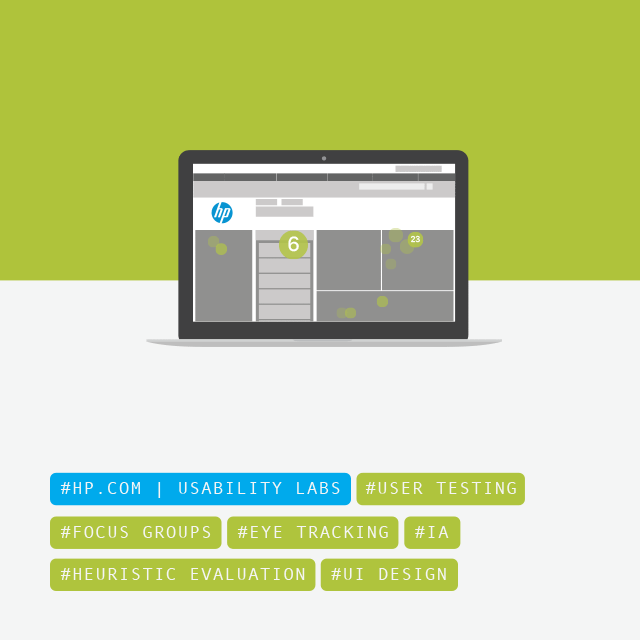
That testing ran in our own usability labs in Hammersmith, kitted out with the cutting-edge tools of the day: eye-tracking software, a one-way mirror for observing users, and an early interactive TV suite for demos and testing. The same lab supported a run of early interactive TV work for clients including Sky and TUI Travel. We designed within the honest constraints of the era: downloadable files, desktop publishing formats and early browsers, all shaped into a journey a busy business owner could actually finish.
Outcome
The work formed part of a wider HP move toward self-service marketing creation for small businesses, and HP kept investing in the model. It became the publicly named HP Creative Studio and HP Creative Studio for Business (the same product line), expanding internationally, including into the UK, with in-house design-and-print positioned as a clear cost saving against traditional print.
Why it still matters
This is, in effect, an early version of today's design-to-print economy. The pattern we helped shape (browse a template, customise it, print or order it) is now the default, mainstreamed by tools like Canva. Useful proof that the people behind New Brand Media were designing and lab-testing self-service design systems two decades before the category had a name.
Context & coverage
The proposition we worked on is well documented in its later public form. HP Creative Studio and HP Creative Studio for Business gave consumers and small businesses a single entry point to free templates, identity and presentation kits, royalty-free imagery and online classes, partnering names like Martha Stewart Living, Disney and DreamWorks on the consumer side and StockLayouts, iStockphoto, Corel and Intuit for small business. The pitch was explicit: create professional marketing materials in-house without hiring a design agency.
- HP Creative Studio (StockLayouts), HP introduces small business marketing tools (Duct Tape Marketing), and DIY small business marketing materials (Small Business Computing): the design-and-print proposition and its partner ecosystem.