NSPCC: corporate website design for a national children’s charity
The client
The NSPCC is one of the UK's best-known children's charities, and its website works harder than most. It is where people come to donate, to join campaigns, to find advice, and to reach safeguarding information, often at moments that matter. Every one of those visitors has to trust what they see.
We worked on the account at NetDecisions / Agilisys. Jonathan was senior designer on the engagement (distinct from later New Brand Media work such as ChildLine Gringtones advertising with Disney).
The challenge
A national charity site serves many audiences at once: supporters, parents, children, and professionals, each arriving with different needs and different levels of urgency. The design had to keep the brand clear and the path to support obvious for all of them. For an organisation like the NSPCC, clarity and trust matter more than visual flourish.
What we did
We designed the NSPCC's full corporate web presence: corporate website design for the charity's main site.
Our approach
We designed for breadth and trust. A clear hierarchy guides each audience to what they need, the routes to give and to get help are unmissable, and the presentation stays calm and dependable, in keeping with the NSPCC brand. Nothing competes with the content, because on a site like this the content is the point.
Outcome
A corporate website design delivered for one of the UK's most recognised children's charities, as design work under NetDecisions / Agilisys rather than a New Brand Media client engagement.
The Prince’s Charities: websites for royal-founded charities
The client
We worked across a cluster of charities under The Prince's Charities umbrella: serious international missions, high public scrutiny, and digital programmes that had to fundraise and communicate at that standard.
Our first engagement was the British Asian Trust, founded in 2007 by the then Prince of Wales (now His Majesty King Charles III, still Royal Founding Patron) with British Asian business leaders, to tackle poverty and hardship across South Asia.
That relationship opened the door to Sentebale, co-founded in 2006 by Prince Harry and Prince Seeiso of Lesotho (younger brother of King Letsie III) in memory of their mothers, including Diana, Princess of Wales. Sentebale means "forget-me-not" in Sesotho. It supports children and young people affected by HIV/AIDS and wider vulnerability across Southern Africa, with programmes rooted in Lesotho and later Botswana.
The challenge
Each organisation needed digital infrastructure and ongoing marketing that could carry a hard story to supporters internationally: clear enough to raise funds, careful enough for the cause, and strong enough to sit beside the people who stand behind it. For the Trust, that meant building a programme from the ground up. For Sentebale, it meant taking on an existing charity operation and making donations, hosting and channels work harder.
What we did
Our first Prince's Charity was the British Asian Trust. We ran their digital programme end to end: strategy, website design and build, hosting, and ongoing support on a monthly retainer, with email marketing and advertising as their primary agency.
The retainer went well beyond the website. When the Trust staged its high-profile royal fundraising events, we provided the technical infrastructure and support behind them: the digital machinery that has to work flawlessly when the room is full of major donors and the founder is royalty. And between events, we ran social media that amplified the Trust's remarkable ambassador network (British Asian Trust ambassadors): names from television, film, music and sport, from Sanjeev Bhaskar and Meera Syal to Gurinder Chadha and Naughty Boy, whose reach turned the Trust's story into a conversation its supporters could join.
That work led to us taking over hosting, technical and marketing support for Sentebale: an existing charity in the same group. Alongside the Trust, we developed Sentebale's online donation infrastructure and social channels on sentebale.org.
// Web traffic
“The site has seen a considerable increase in web traffic.”
Sentebale, Report & Accounts 2012–13
Tone mattered as much as technology. Growing organic support around live events was the goal; getting the voice wrong next to an HIV/AIDS youth mission was not an option.
// Social channels
“Sentebale joined two social media platforms – Twitter and Facebook. We have seen an organic growth in supporters for both platforms with peaks appearing around events.”
Sentebale, Report & Accounts 2012–13
Within the same Prince's Charities group we also delivered microsites and strategic initiatives, including Letsema.org: a collaborative network connecting aid providers working with vulnerable children.
Our approach
// Digital marketing
“Developments in our digital marketing have allowed us to meet our objectives of raising awareness of our work with vulnerable children affected by HIV/AIDS and engaging with our supporters.”
Sentebale, Report & Accounts 2012–13
We treated the cluster as one client relationship with distinct brands inside it: strategy and build where a programme needed founding, hosting and technical stewardship where it already existed, and retainer marketing (email, advertising, social, donations) where the charity needed a primary digital agency. Clear information architecture and design that earns trust sat underneath all of it.
Outcome
Sentebale Report & Accounts 2012–13
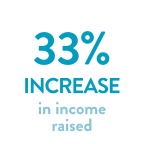
In the period covered by Sentebale's 2012–13 Report & Accounts, the charity reported £3.21 million income raised: a 33% increase on the previous year.
That figure sat on top of a wider Prince's Charities brief that went well beyond a brochure website: live programmes that had to perform on ordinary Tuesdays and on nights when the room was full of major donors, royalty and the Trust's ambassadors. Digital had to be as reliable as the cause was visible.
For Sentebale, the same period shows what happens when donations, hosting and social are treated as one system rather than afterthoughts. The charity's own reporting points to rising traffic, supporter communities that grew around live events, and digital marketing that met its awareness and engagement objectives.
Both organisations went on to do what those foundations were built for. The British Asian Trust has grown into a major force against poverty across South Asia, with His Majesty King Charles III still its Royal Founding Patron. Sentebale continues its work with children and young people in Lesotho and Botswana, marking its 20th anniversary in 2026. Being trusted to build and run digital for causes at that level remains some of the work we are proudest of.
Context & coverage
British Asian Trust: our story: founded 2007 by King Charles III (then Prince of Wales); Royal Founding Patronage continues.
Sentebale: mission, Lesotho and Botswana programmes, established 2006.
Sentebale co-founders: Prince Harry and Prince Seeiso of Lesotho; "forget-me-not" meaning; founded in memory of their mothers, including Diana, Princess of Wales.
Sentebale Report & Accounts 2012–13 (PDF): sentebale.org launched December 2012; social channels from February 2013; digital marketing and year-at-a-glance figures (£3.21m income, 33% increase); Letsema network programme.
United Grand Lodge of England: website and CMS for the home of English Freemasonry
The client
The United Grand Lodge of England is the governing body of Freemasonry in England, Wales and the Channel Islands, headquartered at Freemasons' Hall on Great Queen Street in London. It oversees thousands of lodges and a membership in the hundreds of thousands, and it carries centuries of history and a degree of public curiosity that few brands do.
This was a New Brand Media engagement, with Jonathan leading the design.
The challenge
An institution this old and this private has a particular web challenge: present itself clearly and credibly to the public, support its members and lodges, and do so with a content management system the organisation could maintain itself, all while respecting the dignity and discretion the body expects.
What we did
Website and content management system design for the United Grand Lodge of England: the public website and the CMS behind it.
Our approach
Design for clarity and trust over a maintainable content platform, so a large, tradition-bound organisation could present itself well online and keep the site current without outside help.
Outcome
A website and CMS delivered for one of the most historic institutions in the country, a direct New Brand Media engagement. The organisation maintains a significant web presence to this day at ugle.org.uk.
Context & coverage
The United Grand Lodge of England was established in 1813 (its predecessor, the premier Grand Lodge, dates to 1717) and is based at the Grade II* listed Art Deco Freemasons' Hall, built as a memorial to Freemasons who died in the First World War. It governs thousands of lodges and a membership of around 170,000.
Content merged into visit-britain-2. This slug is hidden from /work and redirects to the canonical case study.
Encyclopaedia Britannica: the reference giant’s first move online
The client
Encyclopaedia Britannica is one of the most established names in reference publishing. By the late 2000s its audience had moved decisively online, and the brand needed to make its first move onto the web without losing an ounce of the authority the name carries.
We worked with Britannica directly on the main Encyclopaedia Britannica UK website: the brand's first foray online, with our team leading design, development and the publishing platform behind it.
The challenge
A heritage reference brand going online for the first time walks a narrow path. The site had to feel as authoritative as the books on the shelf, welcome a broad public audience, and give the publishing team a practical way to keep a vast reference catalogue current.
What we did
We designed and built the main Encyclopaedia Britannica UK website on a content-managed platform: the look, the user experience and the publishing foundation behind the brand's first online presence.
Our approach
We designed for trust and clarity, pairing a clean, confident visual language with a content-managed platform so the publishing team could keep the catalogue up to date without the design quality ever slipping.
Outcome
We took one of the world's most trusted reference brands online for the first time in the UK, delivering a website that carried Britannica's authority onto the web and gave the team a platform they could run themselves.
Context & coverage
By 2008 Britannica's shift to digital was well under way. Britannica Online had existed as a subscription service since 1994, CD-ROM editions had run through the 1990s, and a mobile site arrived in 2008, with a community feedback system added to Britannica.com in the same era. The print edition was still profitable but increasingly sold to schools and libraries, and the company would drop print entirely in 2012. A first dedicated UK website fits exactly this period of a heritage reference brand reorganising around the web.